
ISC
Published in collaboration with NCMS
Digital Manufacturing Report

News & information about the fast-moving world
of digital manufacturing, modeling & simulation

Language Flags

Reshoring Into American Eco-Industrial Clusters


As the reshoring trend is gaining strength, it is important to evaluate innovative, alternative solutions to the past industrial models. Otherwise, it might be difficult to ensure that the return of manufacturing in the US will be resilient in response to any future attempts of delocalization in serving the domestic market.

There are a few main options to choose from as the decision to reshore is being made. Companies can restart existing plants with no upgrades, partial upgrades or complete overhauls. Alternatively, they can acquire new plants either by building them of buying them.

The reshoring location will thus be at the core of the decision process. I, among many others, would prefer to see a new economy being built after the great recession, based on sustainability criteria. How can the decision on reshoring location be linked to sustainability? Through the eco-industrial cluster or park.

According to OECD’s definition, an eco-industrial park is “a cluster of companies that cooperate closely with each other and with the local community to share resources, to improve economic performance and minimize waste and pollution. The collective benefit is considered greater than the sum of the benefits companies would realize when optimizing only their individual performance”.

Eco-industrial parks are the latest and most systemic form in the evolution of sustainable manufacturing concepts and practices:
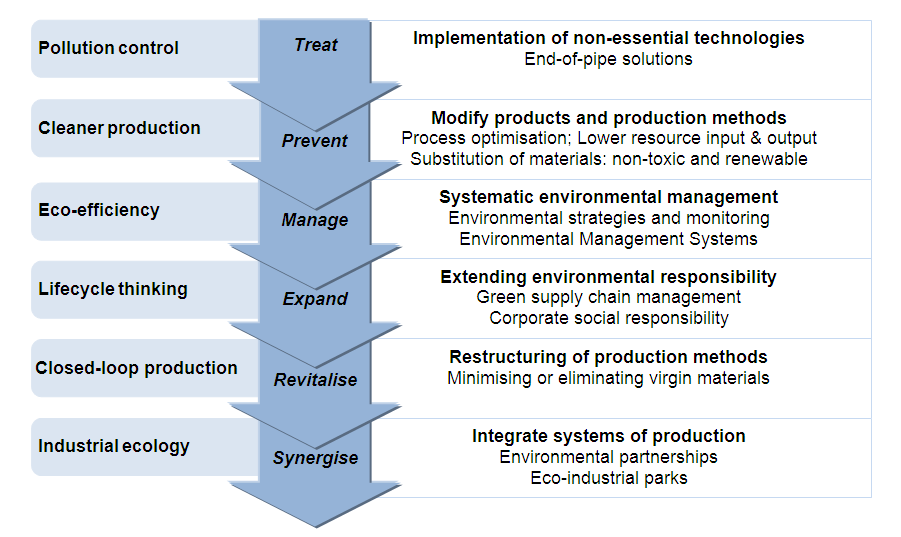


What is the difference between eco-industrial clusters and traditional industrial or technology clusters? The following are some of the characteristics of the eco-industrial clusters which make them more attractive to reshoring for the long-term:

  • Diversity of industries, providing a hedging strategy against the negative impact of the business cycle in a homogenous industrial cluster where companies are in-sync
  • Highly collaborative rather than competitive, between all entities involved, private and public 
  • Provide risk mitigation against material, energy, transportation price volatility and increase
  • Induce innovation in product design, production processes and services through the pro-active search of finding usage for all the waste or by-product streams available 
  • Create positive economic externalities through stable employment, regional sustainable development, elimination or reduction of land used for landfills, reduced regional ecological footprint with associated lower health and other social costs
  • Open to continuous expansion thought the availability of waste or by-product streams to new users

The global benchmark and the oldest eco-industrial park in continuous existence and expansion since 1961 is the Kalundborg Symbiosis in Denmark (pictured below with its 2011 structure)


Based on the experience at Kalundborg, there are five criteria for a successful industrial symbiosis. First, all projects must be economically feasible. The included members must then fit together, although can be different. Similarly, the ideological and geographical distances between members must be small. Then, members must focus on large, continuous waste streams.

In the US, the By-Product Synergy (BPS) network managed by the United States Business Council for Sustainable Development (US BCSD) has been expanding since 1997. Their stated goals are:

  • Reduced resource use – energy, water, petroleum, natural resources
  • Reduced carbon emissions resulting from the reuse of existing materials rather than use of new materials with a carbon generating extraction/production stream
  • Reduced waste to landfill and reduced processing and disposal costs of hazardous materials
  • Innovations in manufacturing discovered and developed for efficiency and productivity
  • Opportunities to address regulation issues and reduce barriers to materials exchange processes

US BCSD is planning to have 20 US cities with ongoing by-product synergy programs by 2015. These cities could make a good reshoring location for anchoring the future eco-industrial clusters.

RSS Feeds

Subscribe to All Content

Most Recent Blogs


Feature Articles

Understanding Fluid Flow in Microchannels

The ability to control fluid streams at microscale is of great importance in many domains such as biological processing, guiding chemical reactions, and creating structured materials. Recently, it has been discovered that placing pillars of different dimensions, and at different offsets, allows fluid transformations to “sculpt” fluid streams.
Read more...

Floodgates Open for the Industrial Internet

So far, the story surrounding the industrial Internet has been centered around GE, and their plans to infuse their factories with thousands of sensors that will bring big data to manufacturing. But after record-breaking floods from Hurricane Sandy took their toll on New York and New Jersey, environmental and civil engineers have found a new application for the Internet-connected sensor system.
Read more...

GM Invests in HPC Center for Crash Test Simulations

As the cloud becomes an increasingly attractive option for manufacturers with big needs in IT, scalable options such as outsourced data centers have become a must-have for many companies. But General Motors has taken a step in the opposite direction when its $130 million datacenter went online Monday in the suburb of Warren, Michigan.
Read more...

Short Takes

MIT Improves Carbon-Fiber Composites

May 22, 2013 | While advanced carbon-fiber composites have been used in the recent years, researchers are searching for materials that are even stronger and lighter. Composites made with carbon fibers coated with carbon nanotubes are being considered because they can be hundreds of times stronger than steel and only one-sixth the weight.
Read more...

NASA to 3D Print the Future of Food

May 22, 2013 | NASA has awarded a $125,000 grant for a project intended to 3D print food for astronauts in space. The printer will mix together basic nutrients such as oil and protein powder to create the food. It will also allow the user to input their sex, age, and weight so that it can make the food based on the individual's own nutritional needs.
Read more...

Airbus Enters the Composite Class

May 17, 2013 | This week, Airbus towed its newest airliner, the A350 XWB, out of its hangar and is poised to roll it into the spotlight of the upcoming Paris Air Show. The A350 XWB has been designed with the goal of surpassing the 787 in fuel efficiency and comfort, and has forgone metal for composite materials to make it happen.
Read more...

3D Printing Meets Augmented Reality

May 16, 2013 | Sander Veenhof and Joris van Tubergen, of the Netherlands, joined their skills in media art and design to merge 3D printing with augmented reality. They call the result "UltimARker" and like the 3D printer it works with it's been designed for the open source community to give consumers more detailed information about their 3D printer.
Read more...

Could a Driverless Highway Be Around the Corner?

May 16, 2013 | A recent survey by Cisco Systems found that 57 percent of consumers worldwide are in favor of using driverless cars, with 60 percent approval in the United States, suggesting that the world might be more ready for autonomous vehicles to hit the road than previously thought.
Read more...

Sponsored Whitepapers

Big Data and Big Analytics for Product and Process Quality

03/20/2013 | SAS | This white paper examines how an enterprise-wide quality platform can turn existing data into substantial and sustainable revenue growth and cost savings for global manufacturers. The paper is based on the findings of the IW/SAS Enterprise Quality Survey completed by more than 400 manufacturing executives. The objectives of the survey were to determine concerns about quality among manufacturers; investigate the tools used to measure quality; and examine how using enterprise-wide analysis on quality data improves performance.

TATA Steel Automotive Engineering Depends on Univa

07/19/2011 | Univa | TATA Steel Automotive Engineering’s concern grew when open source Grid Engine support and development was discontinued by Oracle. Grid Engine is a business critical application in their environment. They recognized the likelihood that product enhancements and innovations would cease. Read how TATA Steel Automotive Engineering moved from a self-support solution to Univa Grid Engine. You can get more out of your environment and your budget with Univa Grid Engine.

Intersect360 HPC500 Conferences and Events

Featured Events


Copyright © 2011-2013 Tabor Communications, Inc. All Rights Reserved.
Digital Manufacturing Report is a registered trademark of Tabor Communications, Inc. Use of this site is governed by our Terms of Use and Privacy Policy.
Reproduction in whole or in part in any form or medium without express written permission of Tabor Communications Inc. is prohibited.
Powered by Xtenit.