

Ten Minutes with Jon Riley: Michigan Manufacturing to Get a Boost
 Jon Riley
Last fall the National Center for Manufacturing Sciences (NCMS) announced that it had partnered with the Michigan Economic Development Corporation (MEDC) to establish the first innovation center in what will become a national grid. The centers help will small- and mid-sized manufacturers (SMMs) be more competitive globally by providing them with a virtualized approach to product design and manufacturing that combines high performance modeling, simulation, and analysis (MS&A), data mining tools, and the digitization of processes to optimize speed, reliability, and efficiency.
Jon Riley leads the effort for NCMS. We asked Jon to bring us up to date on what’s happening with the initiative since it was announced last November.
Here’s what he had to say.
DMR: Jon, NCMS and its partners announced the first digital manufacturing innovation center last fall – what’s happened in the intervening few months?
Jon Riley: Progress is moving ahead quite nicely. The Michigan innovation center has been in the works for just about a year and we’re engaged with a large contingent of participants. When it became a funded opportunity last fall, NCMS was off and running with a number of our digital manufacturing Strategic Interest Group members to determine the necessary next steps. We realized that the key was to have an anchor stakeholder from the state of Michigan.
DMR: And that’s where GE came in?
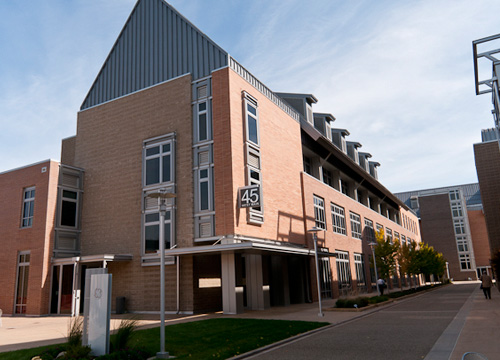 JR: NCMS has had a long-standing relationship with GE, and it has been an active member of the SIG since the very beginning. GE has also made an enormous investment in the state of Michigan, which includes a major research center near the airport, about 30 minutes from NCMS world headquarters. Partnering with them was a no-brainer.
(Photo shows GE’s Advanced Manufacturing and Software Technology Center)
NCMS started working with GE and the state of Michigan and agreed to create an advanced materials innovation center focused on two main goals. The first is to bring technology to GE: help them develop lower cost composites in everything from aircraft engines to windmill blades. We’re all involved and stand to benefit. GE wants to refine their technology, the state wants to nurture its small to medium sized manufacturers to drive economic opportunity, and NCMS wants to support innovative manufacturing and delivery technology through collaboration – something we’ve been doing for 25 years.
So, we have these three organizations coming together to develop what we’ve been calling a predictive innovation center for the last couple of years. Now that we’re funded, we’re into the first three to six months of the tedious but essential paperwork piece of the initiative. Overall, we are working with about 20 organizations – software vendors like Altair, ANSYS, Dassault, and potentially AutoDesk. Intel and other technology providers are involved as are a number of SMMs and some very large manufacturers.
DMR: What’s the overall structure of the project? In Michigan and across the board?
JR: I see the entire project as falling into three distinct buckets of effort.
The first is our work with GE on furthering their composite efforts, which is one of their primary activities at the center here in Michigan. Ford and General Dynamics are also involved. That project is now in the development phase and the final statement of work should be done end of this month or early February.
It is primarily focused on laminated composite structures subjected to high strain rates – anything from ballistics down to quasi-static test conditions. The project has become the core, initial effort to launch the innovation center. It’s the first formal collaborative R&D activity, the project that will launch a nationwide revolution in how America builds. So the steps, the stuff you do to initiate the activity, should be done in the first quarter. The project will be fully up and running by Q2 2013. So that’s the first thing.
In conjunction with our work on this initial project we will be creating the innovation center itself. That activity is the second bucket or the next layer of the onion to mix metaphors. This effort will initially engage SMMs in the state of Michigan and then throughout the entire region.
This to me is most fascinating part. We will have a multi-agency effort in Michigan – this is not just NCMS looking to help one or two companies. Involved is a team made up of organizations backed with funding from a number of federal agencies partnering with NCMS, GE and state of Michigan. Those agencies include the National Institute of Standards and Technology, the Department of Commerce, and the Department of Energy. They have all applied funding for specific engagements in the region and that funding is obviously leveraging NCMS networks. But also included are the Michigan MEP center, and other workforce development organizations such as WIN – the Workforce Intelligence Network for Southeast Michigan – and the Detroit Regional Chamber’s Connection Point. There’s a lot of interest on the part of federal funders to partner with the state of Michigan to bring advanced manufacturing technology to its SMM contract manufacturers, because doing so will mean a long-term economic growth opportunity. It will mean jobs, good jobs, across many disciplines.
Remember, we’re not just viewing the innovative center engagement solely through the perspective of an OEM. General Electric, General Dynamics and Ford are obviously key stakeholders, but this is a multipronged approach involving many other agencies and centers here in the state. This will create a very diverse outreach and a lot of touch points, especially when the innovation center is up and running.
DMR: And the third bucket?
JR: The third bucket is the actual engagement. Once we find these companies that need help, what do we do with them? This calls for a whole separate set of tasks that virtually and physically align these companies.
On the virtual side, we are in the process right now of developing a substantial web presence. For the grid concept – the national, cross-discipline collaboration – to work, you need a robust online element with resources such as hardware, software, training, expertise, and consulting, which will available this year to the SMMs. We expect the web site’s content and capabilities to grow significantly over time. Even at this early point a huge, more than twenty I think, a huge number of potential partners have already expressed interest in basically aligning with the innovation center initiative on their own dime including providing in-kind resources to make it a reality. That’s one of the beauties of the NCMS model – the ability to generate this kind of enthusiastic involvement, because everyone’s going to win.
On the physical side, the center is taking shape on the property at General Electric. We’re in the process right now of outfitting the facility and are collaborating with GE on all the facilities work needed to get the actual space completed. This should be completed in next four to six weeks and will be ready when we launch in Q2. There will be hands on engagement in the center and, in addition, GE has offered us conference space that’s used by tenants at the facility to do substantial training. So we are creating a training series where you can learn essential information not just about what we’re doing, but how you can use the tools we’re making available.
 DMR: Can you give some examples of the training?
JR: Oh, we have a lot of stuff planned. Physics topics relevant to digital manufacturing, like the basics of FEA (finite element analysis) and fluid dynamics. Materials science training. Advanced modeling, simulation and analytics, using simulation to optimize designs and processes. ISVs will provide training on how to use specific software tools. Also lots of classes will be offered over the web, including webinars and remote training. We have been working with NAFEMS, an independent, not-for-profit membership association that sets and maintains standards in computer-aided engineering that also does a lot of training. We’re partnering with them to make their training available through the innovation center.
DMR: It sounds like things are moving right along, especially given that the announcement was only a few months ago.
JR: NCMS is really good at making efforts like this a reality, and our initiative here seems to resonate with a lot of people. I’m happy to report that at this juncture we have at least 20 companies that have expressed intense interest in the initiative. The list of firms that have contacted us reads like a Who’s Who in the manufacturing industry. They will help us attain our goal for year one of this three year effort – to put a stake in the ground and demonstrate a viable and sustainable way of helping SMMs accelerate manufacturing by providing easy access to advanced digital manufacturing tools and technologies. And it’s only the beginning, really. Almost every day we hear from ISVs, big manufacturers, universities, all of them wanting to know how they can become part of it. That’s a very exciting thing for me. I’ve believed in this for a long time, and seeing this interest, this swell of interest in what’s coming together, that means others believe in it too. It’s not just NCMS, and it’s certainly not just me. It’s the collaboration that’s going to change the way America builds.
DMR: Jon, thank you for your time.


