


Capturing the Unicorn: The Lure of Affordable High Tech Bike Racing Wheels
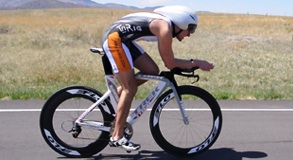 Last week we wrote a feature story about the use of computational fluid dynamics (CFD) in the design of bicycle racing wheels. Here’s a companion piece, this time featuring FLO Cycling, one of those small- to medium-sized manufacturers (SMMs) that have been dubbed the “missing middle.” Missing middle SMMs have yet to adopt advanced digital manufacturing techniques. FLO is far from missing. In fact, the two-year old company is an avid user of CFD.
According to a write up by Justin Smothers, JCS Engineers, Jon Thornham and Chris Thornham, FLO Cycling, and Prashanth Shankara, CD-adapco, FLO Cycling has leveraged CFD to bring to market what has been dubbed the “mythical unicorn” of the bike racing world – a high-performance, superior, aerodynamically designed bike wheel at an affordable price.
A Matter of Money
Here’s the problem. Well engineered, high-end bike wheels are expensive – often costing several thousand dollars. At the other end of the spectrum, affordable wheels, although well manufactured are minimally engineered and offer a much reduced level of performance.
FLO’s target market consists primarily of triathlon racers and cyclists. They can be just as demanding as the pros. However, most of them can’t afford the high-priced competitive wheels, but still want top performance from their lower cost models.
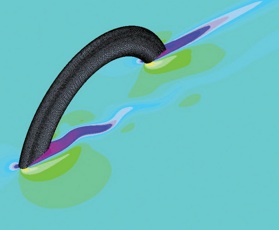 To meet these requirements, FLO cut some of their production costs by fine tuning their marketing and distribution strategy by selling direct to the customer. But a major factor in collaring the mythical unicorn has been the use of modeling and simulation in the form of CFD and wind tunnels in the development process. The CFD software used by FLO is CD-adapco’s STAR-CCM+.
Most bicycle wheel manufacturers employ the V-notch or the Toroidal Fairing configuration for designing competitive racing wheels. The V-notch has low aerodynamic drag but can be unstable in crosswinds because of asymmetry between the front and rear half of the tire. The Toroidal Fairing provides better crosswind stability compared to the V-notch.
Side winds create a complex aerodynamic situation including a yaw angle at the leading edge of the wheels, resulting in side forces that have to be taken into account in the wheel design. During side winds, the design of the leading edge of the back of the wheel also impacts aerodynamics.
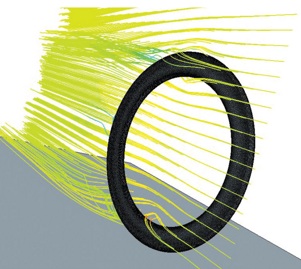 Using CFD as part of the design process, FLO has created a rounded-edge back wheel to deal with this problem. The company’s wide fairing design provides a nearly identical front and rear half of the wheel. The rounded rear edge closely matches the profile of the tire, rather than presenting a pointed rear half. The result is greater crosswind stability and excellent aerodynamics.
FLO also applied something called Net Low Drag Technology. Most current racing wheels provide low drag and fast speeds at one particular yaw angle. But in a race, yaw angles can vary from 10 to 20 degrees. FLO’s designs ensure the fastest speed at all yaw angles between 12 and 20 degrees.
The optimum rim and fairing shapes were selected based on CFD results. To really be effective, CFD should be used from the very beginning of the design process. This allows the engineers and designers to try out a wide variety of shapes and solutions to determine what geometries produce the optimum results. Then they can perform the more expensive wind tunnel tests on a few of the most promising solutions. When the best design has been selected, the next step is to send CAD drawings to a mold maker who creates a set of custom molds. The whole point is to design and refine the rim shape for optimal aerodynamics before a mold is opened.
The CFD Experience
To come up with the designs for their innovative wheels, FLO mad full use of CFD to determine the final fairing design. First a variety of fairing shapes based on the FLO wide Toroidal wheel were created in a CAD environment. These shapes were analyzed using STAR-CCM+ and tested for a wide variety of race conditions, including wind speeds ranging from five to 30 mph, and yaw angles from zero to 20 degrees.
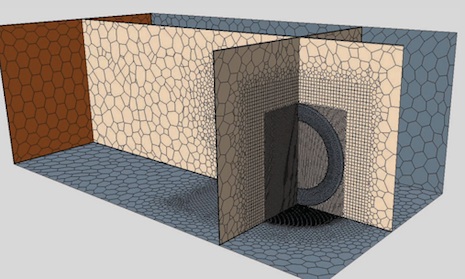 The designers created a polyhedral mesh with 1.5 million cells for the CFD analysis. This included a prism layer mesh to capture the boundary layer flow on the wheel. They also used the CFD software’s volumetric refinement feature to create local refinement zones around the wheel so they could analyze the wheel’s wake.
The designers were able to change the wind speed and yaw angles for each iteration of the design. Simulations were run on a single core over a period of 28 days – a supercomputer wasn’t necessary (although the authors admit that the extra compute power would have gotten the job done faster).
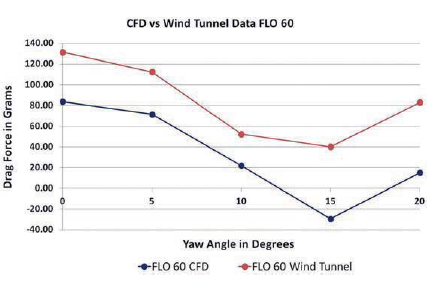 CFD also allowed the engineers to cut down on wind tunnel tests, saving money and speeding up the design process. The chart compares the drag force from CFD simulation and wind tunnel for the FLO 60 final prototype. The numerical results gave the engineers invaluable insights into the wheel’s behavior before testing a single prototype in the wind tunnel.
When the wheel finally made it to the wind tunnel, and there were no surprises – the CFD analysis had paved the way for successful physical prototype testing.
 And, in the process, FLO made the “mythical unicorn” a reality.


