January 15, 2013

As we witness the rise of 3D printing, one particular application has proven exceptionally useful: metal printing. Most recently, we reported on NASA's selective metal melting (SLM) method for manufacturing complex rocket engine components, helping to unlock the doors to a future of interstellar travel.
But in order to appreciate the promise of 3D metal printing, we must consider the significant bounds made in 3D printing in the past year alone, as it represents one of the fastest growing technologies today.
Despite numerous recent innovations, metal printing can trace its origins back to the 1880s, when welders used carbon electrode arcs to lay down metal beads. Since then we've developed electron beams and vacuum chambers, but the most important breakthrough has arguably been the laser.
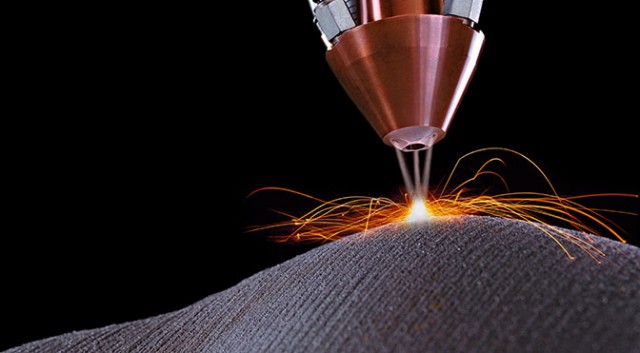
The first laser replaced the oxygen-acetylene torch for welding powdered metal, transforming a relatively crude technique for motor shaft reinforcement into a powerful and precise construction tool. Laser metal deposition welding is accomplished with a device that pipes a laser down through central bore that merges with a powdered metal feedstream at the device's tip. The laser then fuses the metal to the target surface. The process is illustrated in the following video, courtesy of Trumpf, the maker of one such device.
;
But the fastest metal printing process far and away is the deposition of a powder matrix containing binders. The binders melt to temporarily hold the metal powder before it is fused in a specialized oven.
One company that has jumped on the potential of this manufacturing process is Shapeways, which has allowed customers to implement custom designs, such as smartphone cases, at a relatively low cost. The only drawback is the weak magnetism of the stainless steel used by their process, which could be enough to damage certain electronics but not strong enough to offer additional utility. But if the direction of the additive manufacturing industry is any indicator, this roadblock too shall pass.
And what about the future? Two technologies could enable the production even higher resolution parts. Two-photon laser curing can pass through a material without reaction until it reaches a specially designed binder. Similarly, the femtosecond laser is transitioning from micromachining and corrective eye surgery to the additive manufacturing world, held back only by the expense of its sapphire crystal core.
But if we manage to 3D print the sapphire in question? Well, that could change everything.
Full story at ExtremeTech
So far, the story surrounding the industrial Internet has been centered around GE, and their plans to infuse their factories with thousands of sensors that will bring big data to manufacturing. But after record-breaking floods from Hurricane Sandy took their toll on New York and New Jersey, environmental and civil engineers have found a new application for the Internet-connected sensor system.
Read more...
As the cloud becomes an increasingly attractive option for manufacturers with big needs in IT, scalable options such as outsourced data centers have become a must-have for many companies. But General Motors has taken a step in the opposite direction when its $130 million datacenter went online Monday in the suburb of Warren, Michigan.
Read more...
When we talk to manufacturers of any size, one concern across the board has been finding engineers with sufficient education and training to do their job. Taking one step toward alleviating this issue is Siemens, who have launched a U.S. job training initiative for veterans, hoping to round out the training of engineers throughout the country.
Read more...
May 17, 2013 |
This week, Airbus towed its newest airliner, the A350 XWB, out of its hangar and is poised to roll it into the spotlight of the upcoming Paris Air Show. The A350 XWB has been designed with the goal of surpassing the 787 in fuel efficiency and comfort, and has forgone metal for composite materials to make it happen.
Read more...
May 16, 2013 |
Sander Veenhof and Joris van Tubergen, of the Netherlands, joined their skills in media art and design to merge 3D printing with augmented reality. They call the result "UltimARker" and like the 3D printer it works with it's been designed for the open source community to give consumers more detailed information about their 3D printer.
Read more...
May 16, 2013 |
A recent survey by Cisco Systems found that 57 percent of consumers worldwide are in favor of using driverless cars, with 60 percent approval in the United States, suggesting that the world might be more ready for autonomous vehicles to hit the road than previously thought.
Read more...
May 10, 2013 |
We've known since Obama's State of the Union address this year that 3D printing is a key pillar in the president's plan for America's future in manufacturing, but on Thursday this was made even more clear with the announcement of a competition to create three manufacturing innovation institutes, to be modeled after a government-funded 3D printing center.
Read more...
May 09, 2013 |
Finally, we have someone to look to when we have to assemble our IKEA furniture--or at least something. This week, this solution was showcased at the IEEE International Conference on Robotics and Automation, proving that robots might soon be surpassing humans at yet another task. At least we can gladly hand this one over.
Read more...
03/20/2013 | SAS | This white paper examines how an enterprise-wide quality platform can turn existing data into substantial and sustainable revenue growth and cost savings for global manufacturers. The paper is based on the findings of the IW/SAS Enterprise Quality Survey completed by more than 400 manufacturing executives. The objectives of the survey were to determine concerns about quality among manufacturers; investigate the tools used to measure quality; and examine how using enterprise-wide analysis on quality data improves performance.
07/19/2011 | Univa | TATA Steel Automotive Engineering’s concern grew when open source Grid Engine support and development was discontinued by Oracle. Grid Engine is a business critical application in their environment. They recognized the likelihood that product enhancements and innovations would cease. Read how TATA Steel Automotive Engineering moved from a self-support solution to Univa Grid Engine. You can get more out of your environment and your budget with Univa Grid Engine.
Copyright © 2011-2013 Tabor Communications, Inc. All Rights Reserved.
Digital Manufacturing Report is a registered trademark of Tabor Communications, Inc. Use of this site is governed by our Terms of Use and Privacy Policy.
Reproduction in whole or in part in any form or medium without express written permission of Tabor Communications Inc. is prohibited.
Powered by Xtenit.