


Meet the e-Bee: Designing the Automotive Interior of the Future
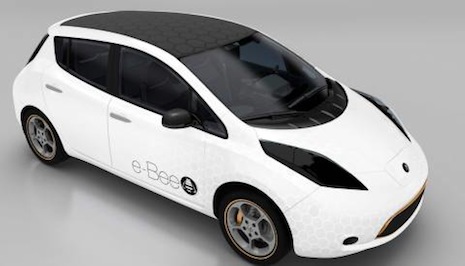
What will automotive interiors in the year 2020 look like? If you take a look at Visteon’s e-Bee vehicle concept you just might have a sneak preview.
Visteon, an international company headquartered in Van Buren Township, Mich., has caved out a lucrative niche for itself as an automotive supplier that designs, engineers and manufactures innovative climate, electronic and interior products for vehicle manufacturers.
With some 22,000 employees, Visteon revenues for 2011 were $7.53 billion, earning them a place on the Fortune 500. The company has manufacturing, technical, sales and service facilities in 28 countries. The e-Bee concept is a direct appeal to its automotive OEMs that spend a lot of time and energy trying to decipher the future needs of their customers. (And sometimes failing mightily: remember the Ford Pinto, the Edsel, the Pontiac Aztek, the Jaguar X-Type, and everyone’s favorite, the DeLorean DMC-12?)
Visteon is basing its vision of the not too distant future on what it learned from its previous C-Beyond concept, which stressed simplicity and an ergonomic interface for drivers and passengers. The e-Bee concept retains the emphasis on simplicity, while adding flexibility and frugality to the mix.
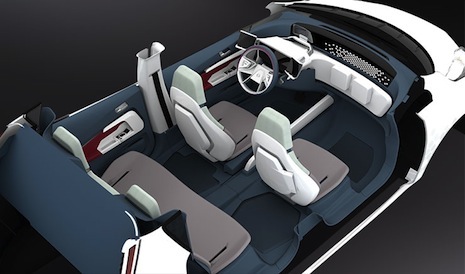
Flexibility is achieved by creating a basic architectural setting for all regions around the globe, complemented by a user-interface structure that can accommodate regional needs and the demands of that specific market sector. The GUI, illumination environment, and physical app accessories will allow complete personalization and reconfigurability. Frugality is achieved by designing the auto interior with layered, discrete levels of structure and interface hardware that allows the OEM to scale the solution as needed and eliminate regionally unnecessary elements.
Mid-range infotainiment platform
Among the many climate features are an integrated climate system module and such smart energy management technologies as an electric compressor and heat-pump system – the concept even includes a cluster ion generator for on-board comfort. As you might imagine, a wide range of electronics are featured, including, under the rubric of car cloud connectivity, a mid-range infotainment platform that enables multi-device connectivity and content management.
The interior architecture of the vehicle reflects the same attention to detail and well-thought-out design concepts. For example, the car interior can be easily cleaned and is adaptable, allowing the owner to reconfigure the space after sale. A distinctive lighting scheme using multicolor indirect light sources makes for an enhanced nighttime ambiance. You can see a full list of the technologies involved on the e-Bee web site.
Global Collaboration
The e-Bee concept is not one of clichéd efforts of a few mad design genius working in isolation to create a breakthrough concept that will rock the auto industry on its heels. Instead, a wide cross section of participants scattered around the globe worked in concert to bring the concept to fruition.
 The endeavor was led by the Visteon Design, Human-Machine Interface (HMI) and Innovation based in Germany. It also involved a number of Visteon divisions, including Design, Innovation, Interiors, Electronics, Climate, and Lighting. Also part of the team were partners such as Sharp for co-innovation, Immersion for HMI, and Estech for both virtual and physical concept development.
The project relied on daily, real-time, intensive collaboration including data sharing between the design, HIM and engineering teams. Among the collaborative efforts was digital design, from concept digital modeling up to the development of class A surfaces (“digital sculpting”). Physical mockups were also created using polystyrene milling for each iteration.
Another set of interconnected projects dealt with trends analysis and data gathering, storyboarding, virtual rendering, and animation creation.
The glue tying all this activity together is the Dassault Systèmes 3DEXPERIENCE platform’s 3DswYm, the company’s social enterprise application that operates in the cloud. According to Visteon, the application allows designers and engineers in multiple regions to work as if they were all in the same room, speaking the common language of 3D. This capability allows the participants to visualize the design as it evolves, supporting their collaborative efforts and speeding up the product development lifecycle.
3DSwYm is used to connect internal Visteon departments and joint venture partners not typically involved in the innovation process. Usually during product development only a few people beyond the engineers involved can share and view the data in real-time. With 3DswYm, the e-Bee collaborators working in this socially shared environment were able to show the initial design in seconds instead of weeks, and feedback from customers, joint venture partners, and suppliers was available in real-time.
The emphasis on fast turnaround in collaborative design and prototyping is particularly important when you realize Visteon is banking on its vision of a future that is five years away – a very long time in a world that is characterized by constantly accelerating change.
Part of Visteon’s vision includes creating profiles of imaginary customers and designing the e-Bee components to meet their wants and needs. For example, in Europe a retired professor and his wife, as well as an urban dwelling young woman characterized as a “new media” specialist with a busy lifestyle share the spotlight. In North America, the e-Bee owner is a 50-year-old man with grown children who uses his car on the weekend for outdoor activities at remote locations.
 And, in China, a 25 year old art editor named Li has personally designed the interior of her e-Bee in striking red and white; she sees the car as an extension of her apartment, supporting her “glamorous” lifestyle.
These fanciful profiles reflect the company’s best guess at what the future may bring. But as author Nassim Nicolas Taleb points out in his book, The Black Swan, at any moment major, unforeseen events can change everything, surprising us because of "our blindness with respect to randomness, particularly large deviations." As the e-Bee project evolves over time and perhaps encounters its own black swan, it will need all the power of its collaborative software to respond.


