


EOS at EuroMold: Helping to Drive a Paradigm Shift?
 EuroMold 2012, held in Frankfurt last week, drew about 1500 exhibitors and some 600,000 visitors. Many came to experience more than just the fair’s customary emphasis on mould and toolmaking. Although these traditional technologies accounted for more than a third of the exhibitors, booths devoted to rapid prototyping and additive manufacturing were very much in evidence. And a harbinger of things to come – for the first time at the fair, awards were presented for 3D printed jewelry.
Rapid technologies, model-making and prototype production accounted for about 22 percent of the booths; design groups, many using 3D technology, added another seven percent.
EOS and Laser-Sintering
One of the busiest vendors at the show was on its home turf. EOS, founded in 1989 and headquartered in Germany, has helped evolve laser-sintering additive manufacturing solutions from a technology devoted to rapid prototyping of limited run components to a manufacturing process that can make production runs using a wide variety of materials. Included in the company’s line up are plastics laser-sintering using EOS PEEK HP3 materials, and direct metal laser sintering that employs such materials as titanium, cobalt chrome and nickel alloys.
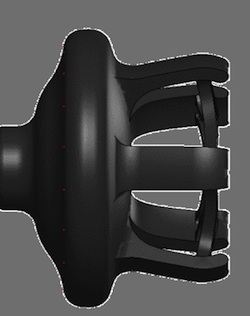
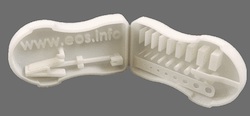
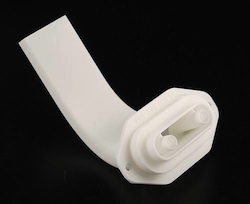
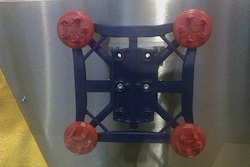 EOS used the fair to showcase its FORMIGA P 110 plastic laser-sintering system, which is geared to economically producing small series and customized products with complex geometries such as the two grippers shown in the photos. According to EOS, the four fold ball bearing gripper was made in an optimized, laser-sintered lightweight design, weighing in at 210 g compared to the 1500 g weight of conventional models, resulting in a reduction in cost and materials. Production times were also shortened. Since production was based on 3D CAD data, special requirements made by EOS customers were implemented quickly and cost effectively.
Other applications for the new system include building small, sophisticated components used in the medical science industry or creating high-value consumer goods. Its build envelope is 200 mm x 250 mm x 330 mm.
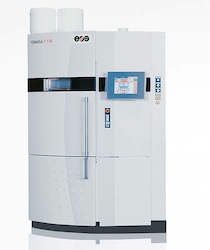 This successor to the company’s FORMIGA P 100 plastic laser sintering system manufactures products made of polyamide or polystyrene directly from CAD data within a few hours. Technical innovations include newly designed 4-channel heating and the use of single-point pyrometer. The extremely small focus diameter enables the production of walls that are only 0.16 in thick. An external nitrogen connection allows least-cost integration in factories with a central nitrogen supply system.
The system can process precious metal parts made of 18 carat yellow gold for the jewelry and watch industries.
Expanded Materials Portfolio
The company also introduced two new plastic materials at the show that emphasize ecology, technical performance and low manufacturing costs.
 PrimePart Plus (PA 2221) is a polymer material that can be refreshed using only a 30 percent share of new powder, resulting in a powder cycle with minimum scrap. Conventional laser-sintering materials usually require 50 percent or more new powder.
PA 1101 is a new polymer class made of renewing resources to reduce environmental impact. This natural-colored polyamide 11 provides such desirable mechanical properties as high elongation at break and impact resistance. Uses include applications with functional elements that require high material ductility – for example, internal hinges – as well as high impact resistance. Creating components that do not allow chipping – for example, the passenger cell in a vehicle – is another typical application for this material.
Parts Property Management Concept
Also featured at the EOS EuroMold booth was an extension to the EOS Part Property Management (PPM) Concept first introduced at EuroMold 2009.
PPM allows customers to implement EOS standards on several laser-sintering systems, specify individual application requirements, or define customer-specific standards. There are thee basic approaches that customers can choose from:
• The Plug&Print EOS standard defines the PPPs and the customer manufacturers the parts following the standard. This makes for standardization and efficiency throughout the value chain from design to production. Everyone is playing by the same rules.
• Plug&Print EOS Custom is more flexible, allowing individual solutions based on customer specifications. EOS develops the PPPs defined by the customer who then uses them as the basis for parts manufacture. Includes customized modules including systems, material, processes, training and consulting.
• Edit&Print is the most flexible approach, allowing customers to optimize EOS technology to meet their own specific applications requirements. In this approach, the application is carried out at the customer’s premise.
A Disruptive Technology
EOS characterizes Additive Manufacturing as a disruptive technology, setting the stage for a paradigm shift in product design and manufacturing. AM, says the company, does this by accelerating product development, providing freedom of design, optimizing part structures, and enhancing functional integration.
When EuroMold 2013 convenes again next November in Frankfurt, it will be a good time to check and see if the paradigm shift is making headway.


