
December 03, 2012
3D Printing has proven itself revolutionary across sectors: from printing transplant organs to creating specialty movie props. But a single common thread breaches the gap between these applications: customization.
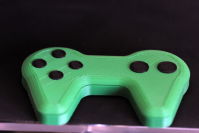
Because of its flexibility, 3D printers are able to create 100 unique products just as easily and quickly as it would take to print 100 identical ones, which means that customized products, from exoskeletons to Invisalign braces are becoming more widely available. Now, that feature is expanding into the gaming industry, due to recent innovations in printing electronic circuitry.
This is the result of research conducted at the University of Warwick, where scientists have created an inexpensive conductive plastic composite, nicknamed “carbomorph.” It works by laying electronic tracks and sensors within the printed structure, which can then be connected to a circuit board.
The next step will be to print more complex structures, such as the circuitry and wires themselves. The end re
sult will be customized electronics, that are made solely through additive manufacturing and, unlike current prototypes, are as functional as their traditionally manufactured equivalents.
The researchers hope that this technology will encourage consumers to invest in personalized devices, such as game controllers molded perfectly to their hands, but that's not the only benefit they anticipate. According to Dr. Simon Leigh of Warwick's School of Engineering, 3D printing will also cut down significantly on both plastic and electronic waste.
Specifically, rather that relying on glues and paints to connect electronic components, these distinct parts will be printed into one whole, potentially increasing longevity and efficiency of the product.
But perhaps the most significant impact this could have will be the ability for young engineers to oversee the production of their own creations – from design to manufacturing – all within the classroom.
So whether this technology is used to create video game controllers known for distracting students from their schoolwork, to helping those same students get ahead in their study of engineering, additive manufacturing is becoming increasingly influential in our day-to-day lives.
Full story at Warwick
The ability to control fluid streams at microscale is of great importance in many domains such as biological processing, guiding chemical reactions, and creating structured materials. Recently, it has been discovered that placing pillars of different dimensions, and at different offsets, allows fluid transformations to “sculpt” fluid streams.
Read more...
So far, the story surrounding the industrial Internet has been centered around GE, and their plans to infuse their factories with thousands of sensors that will bring big data to manufacturing. But after record-breaking floods from Hurricane Sandy took their toll on New York and New Jersey, environmental and civil engineers have found a new application for the Internet-connected sensor system.
Read more...
As the cloud becomes an increasingly attractive option for manufacturers with big needs in IT, scalable options such as outsourced data centers have become a must-have for many companies. But General Motors has taken a step in the opposite direction when its $130 million datacenter went online Monday in the suburb of Warren, Michigan.
Read more...
May 23, 2013 |
In the wake of plastic gun stories, a unique use case for 3D printing helps demonstrate that the additive manufacturing technology's potential to save lives deserves its own place in the spotlight. Now, doctors at C.S. Mott Children's Hospital in Ann Arbor have combined medical expertise with 3D printing's flexibility to save a three-month old.
Read more...
May 23, 2013 |
Researchers have been studying fire ants hoping to learn about their underground navigation skills. They want to apply their findings to making robots that will be able to assist in search and rescue missions for people trapped underground.
Read more...
May 22, 2013 |
While advanced carbon-fiber composites have been used in the recent years, researchers are searching for materials that are even stronger and lighter. Composites made with carbon fibers coated with carbon nanotubes are being considered because they can be hundreds of times stronger than steel and only one-sixth the weight.
Read more...
May 22, 2013 |
NASA has awarded a $125,000 grant for a project intended to 3D print food for astronauts in space. The printer will mix together basic nutrients such as oil and protein powder to create the food. It will also allow the user to input their sex, age, and weight so that it can make the food based on the individual's own nutritional needs.
Read more...
May 17, 2013 |
This week, Airbus towed its newest airliner, the A350 XWB, out of its hangar and is poised to roll it into the spotlight of the upcoming Paris Air Show. The A350 XWB has been designed with the goal of surpassing the 787 in fuel efficiency and comfort, and has forgone metal for composite materials to make it happen.
Read more...
03/20/2013 | SAS | This white paper examines how an enterprise-wide quality platform can turn existing data into substantial and sustainable revenue growth and cost savings for global manufacturers. The paper is based on the findings of the IW/SAS Enterprise Quality Survey completed by more than 400 manufacturing executives. The objectives of the survey were to determine concerns about quality among manufacturers; investigate the tools used to measure quality; and examine how using enterprise-wide analysis on quality data improves performance.
07/19/2011 | Univa | TATA Steel Automotive Engineering’s concern grew when open source Grid Engine support and development was discontinued by Oracle. Grid Engine is a business critical application in their environment. They recognized the likelihood that product enhancements and innovations would cease. Read how TATA Steel Automotive Engineering moved from a self-support solution to Univa Grid Engine. You can get more out of your environment and your budget with Univa Grid Engine.
Copyright © 2011-2013 Tabor Communications, Inc. All Rights Reserved.
Digital Manufacturing Report is a registered trademark of Tabor Communications, Inc. Use of this site is governed by our Terms of Use and Privacy Policy.
Reproduction in whole or in part in any form or medium without express written permission of Tabor Communications Inc. is prohibited.
Powered by Xtenit.