


3D Printer Uses Paper for Prototyping and Production Runs
 When you think of materials used in the 3D printing or additive manufacturing of everything from tiny component parts to entire aircraft wings, workhorse thermoplastics like ABS and Ultem come to mind.
But this is only one part of the picture. The range of materials that can be fed into these printers seems inexhaustible. Titanium is being used to create replacement jawbones; concrete is being fed into giant printers to construct buildings; for those of us with a sweet tooth, chocolate is only a print head away; researchers are now printing functional human tissue with the goal of creating human organs made from cultures of the patients own tissue to eliminate rejection. Or consider a company called Re-Char WOOF (Washington Open Object Fabricators), one of the finalists in a U.K. competition focused on 3D technology for lesser developed countries – WOOF recycles plastic bags to produce tools for local farmers.
But in Ireland over the last several years, a quiet revolution has been underway based on an even more mundane material. Mcor Technologies has developed a 3D printer call the Matrix 300 that uses everyday A4 letter-size paper as its base material. Mcor's CEO, Dr. Conor MacCormack, claims that it's the only paper-based 3D printer on the market. It also offers a unique pricing model. The company has been selling the printer in Europe since 2008 and moved into the U.S. market in 2011, so far providing a few hundred machines to product design engineers and architects in the AEC (Architecture, Engineering and Construction) community.
Hindrance to Growth
MacCormack says the uptake of conventional 3D printers has not been as robust as it might be because of the cost of the consumables. Companies in the 3D marketplace typically sell the printer along with an on-going replenishment supply of materials such as ABS.
Mcor, on the other hand, has inverted the model. Paper, MacCormack notes, as well as being eco friendly, is low in cost. So Mcor gives you the printer for free and charges a fixed fee for a one, two or three year service plan. The maintenance plan covers the adhesive and replacement tungsten carbide blades for slicing the paper. The customer supplies the paper.
MacCormack claims that Mcor's technology lets customers make parts up to 30 times cheaper than comparative plastic models. So, every architectural and design studio can have its own 3D printer because cost is no longer the issue as it is with conventional thermoplastic-based printers.
Using paper as the "ink" the Matrix 3D printer builds objects one sheet at a time, interleaved with a water-based adhesive. Ten sheets of paper, sculpted by tungsten carbide blades, are required to build up 1 millimeter in height.
The printer is particularly suited for creating low cost, rapid prototypes up front in the design process. The creations issuing from the printer are very strong – each layer is subjected to one ton of pressure and when treated after printing, the finished object is more like wood than paper mache or origami. In fact, says MacCormack, the machine is capable of creating parts that are stronger than the equivalent rendered in ABS.
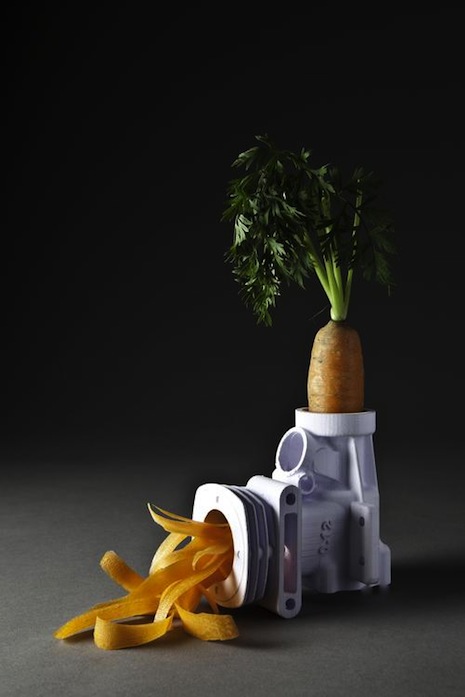 High resolutions, (0.1 mm [0.004 in]) are possible for fine detail of even complex geometries (see the carrot illustration), along with the capability to print from a palette of one million colors at a 300 dpi resolution. This allows engineers and designers to print their prototypes out in full color or add color to the model to indicate the results of stress analysis or flow patterns generated by their CAE finite element analysis (FEA) or computational fluid dynamics (CFD) software. Objects can be created up to 400 cubic centimeters.
For consumer applications, the Matrix allows retailers to create complex full color objects rather than the translucent plastic parts output by conventional thermoplastic-based printers.
MacCormack envisions a near future where consumers with an image of an object they want printed in 3D full color will be able to walk into a FedEx, Office Depot or Staples with a color photo and walk out with the printed results. Apps on your smartphone will allow you to scan images for subsequent printing.
Reprographics Apps
The reprographics industry is another major potential user of the technology, he adds. According to Wikipedia, in the U.S. there are about 3,000 firms serving the large and wide-format reproduction needs of the architectural, engineering, construction, manufacturing, retail, and advertising industries. Photography and xerography are the predominant technologies used, along with laser and ink jet printing. As paper-based 3D printing devices evolve to handle larger formats, these firms can now literally add another dimension to their offerings. An architectural firm, for example, may want a 3D rendering of a building site and its surrounding landscape based on Google Maps aerial and satellite stereo-phogrammetry.
 However, for the time being, Mcor is focused on more earth-bound applications, such as the rapid prototyping needs of the AEC community. The paper-based 3D printers will augment, not replace, other additive manufacturing technology such as Fused Deposition Modeling™, laser sintering, and electron beam melting with their reliance on materials like thermoplastics, metal alloys including titanium, and a variety of ceramic and metal powders. (Let's not forget the chocolate.)
Rather MacCormack's strategy is to create a 3D machine that is "easy to use, eco friendly, low cost, and uses low cost consumables – when your out of materials, you just go to your office supply room and grab some reams of paper. (This approach) makes 3D printing more ubiquitous to everybody."


