October 31, 2012
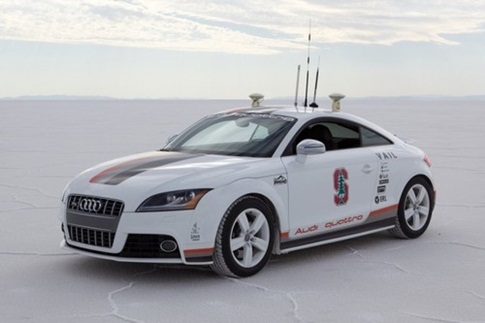
With cars that parallel park themselves, prevent accidents and alert you if you're about to back into your mailbox, it's not too far of a leap to imagine a car that could just drive itself.
As baby boomers are faced with relinquishing the wheel, Generation Y is afflicted with automotive apathy, and everyone in between can't seem to put down their cell phones, a self-driving car looks more and more likely to be heading our way. According to David Strickland, administrator of the National Highway Traffic Safety Administration, this may provide just the impetus necessary for this technology to take off.
To make the NHTSA's dream a reality, the cars' interactions with human drivers and their vehicle-to-vehicle (V2V) communications must reach a fail-safe level of reliability.
Dr. Chris Urmson, director of Google's automated car project, boasts that the company's fleet of Priuses will stop for pedestrians, negotiate mountain passes, and read red lights. But despite Google's accomplishments, this is a far cry from merging with traffic on the highway or backing off from a car whose driver might be looking down at his cell phone. Nonetheless, it is “highway carnage” that Google hopes to put an end to.
Self-driving cars could also enable hundreds of thousands of disabled drivers to maintain or regain their independence. Urmson cited the story of a blind man using one of Google's Priuses to drive himself to Taco Bell to buy a burrito – a level of freedom previously unheard of.
But despite the promise that these cars may hold, there is still the concern over whether consumers would invest in this new market of ultra-safe, automated vehicles. A recent JD Power survey showed great public enthusiasm for these new features, but little interest in paying an additional $2,000 to $3,000 extra for it. Even so, Peter Mertens, senior vice president for research and development at Volvo, remains optimistic, and says that the price will come down with volume, as has been the case with other advancements such as stability or cruise control.
And if society were to accommodate automated cars, who is to blame if crashes occur? The driver? The automaker? This may present the greatest hurdle yet to automakers.
When we compare man and machine, Strickland cites the 33,000 motorists who died in 2010. Human error was to blame in 90 percent of those cases – a vulnerability that machines are immune to by default.
But anyone who has owned a computer or a smartphone knows that machines have weaknesses of their own, and the possibility of your car giving you the Blue Screen of Death seems infinitely more worrisome than driving the car yourself. Because of this, Strickland declined to say when automated cars may hit the market, claiming that they “need to get it right, because if it's not properly handled, consumer confidence will be lost.”
Full story at Txchnologist
At 30,000 feet, equipment failure is simply not an option, which is part of why additive manufacturing has been a bit slow to catch on in the aerospace industry. But according to Michael Idelchik, vice president of GE’s advanced technologies research, GE Aviation is still looking for more ways that additive manufacturing can help to create a better airplane...
Read more...
Despite reassurances of automation professionals throughout the industry, some experts simply aren't convinced that technological advancements in robotics and automation aren't negatively impacting U.S. employment rates, which is what Erik Brynjolfsson and Andrew McAfee of the MIT Sloan School of Management have been arguing over the past year and a half.
Read more...
As far as modeling and simulation are concerned, nautical transportation isn’t one of the first things to come to mind. Still, it presents a unique use case for computer-integrated manufacturing, as the focus of the modeling and simulation is on the construction process itself. By coordinating the insertion of massive hull blocks, it not only streamlines construction, but it improves safety as well.
Read more...
Jun 18, 2013 |
When it comes to testing a new line of trucks, it shouldn’t come as a surprise that automakers such as Ford aren’t afraid to be tough on their latest models. But separating the pounding the trucks can take from the test driver can get a bit tricky, which is why Ford has recently handed the keys over to robots instead of flesh-and-blood drivers.
Read more...
Jun 14, 2013 |
Last month’s news of 3D printers entering brick-and-mortar Staples stores may have represented a major step in mainstream commercialization of additive manufacturing tools, but in what is perhaps an even bigger step, online retail giant Amazon recently added a dedicated section of its site to 3D printers and supplies.
Read more...
Jun 12, 2013 |
In the wake of the economic downturn, reshoring efforts and increased emphasis on STEM, there’s plenty of uncertainty about where global manufacturing is headed in the next several years. Helping to give us a better sense of this trajectory is a group of thought leaders who have come together to try and answer the most pertinent questions about the future.
Read more...
Jun 11, 2013 |
As the U.S. manufacturing sector fights to stay competitive on a global scale, the issue of improving STEM education has been key. But in a recent study measuring how workers in STEM fields are putting their educations to use it was found that half didn't need a bachelor's degree.
Read more...
Jun 10, 2013 |
Chevrolet has added digital manufacturing technology to its arsenal. Abandoning clay for their latest Malibu, the automaker has turned to two types of additive manufacturing to meet their rapid prototyping needs.
Read more...
03/20/2013 | SAS | This white paper examines how an enterprise-wide quality platform can turn existing data into substantial and sustainable revenue growth and cost savings for global manufacturers. The paper is based on the findings of the IW/SAS Enterprise Quality Survey completed by more than 400 manufacturing executives. The objectives of the survey were to determine concerns about quality among manufacturers; investigate the tools used to measure quality; and examine how using enterprise-wide analysis on quality data improves performance.
07/19/2011 | Univa | TATA Steel Automotive Engineering’s concern grew when open source Grid Engine support and development was discontinued by Oracle. Grid Engine is a business critical application in their environment. They recognized the likelihood that product enhancements and innovations would cease. Read how TATA Steel Automotive Engineering moved from a self-support solution to Univa Grid Engine. You can get more out of your environment and your budget with Univa Grid Engine.
Copyright © 2011-2013 Tabor Communications, Inc. All Rights Reserved.
Digital Manufacturing Report is a registered trademark of Tabor Communications, Inc. Use of this site is governed by our Terms of Use and Privacy Policy.
Reproduction in whole or in part in any form or medium without express written permission of Tabor Communications Inc. is prohibited.
Powered by Xtenit.