


SGI Introduces UV 2 Supercomputer: A Machine for the Missing Middle?
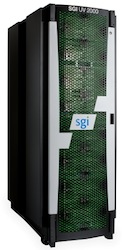 SGI’s newest supercomputer, the UV 2, has the potential to bring more members of the “missing middle” into the digital manufacturing fold. The missing middle refers to those 350,000 small to medium sized manufacturers who have not adopted advanced manufacturing techniques, such as modeling and simulation, due to cost and resource constraints.
The SGI UV 2 system will be formally announced at next weeks International Supercomputing Conference (ISC) in Hamburg. It represents a major upgrade to the original SGI UV1 supercomputer introduced three years ago. Since that time, technological advances in CPUs, memory, I/O and interconnect have allowed the company to offers a machine with twice the amount of cores and four times the memory in a single system at an affordable price.
Jill Matzke, director of server marketing at SGI, refers to the new machine as the “Big Brain.” To live up to that appellation, the UV2 has been designed to handle up to 4096 cores, up to 64 terabytes of coherent main memory, and a peak I//O rate of four terabytes per second. It contains the latest Intel “Sandy Bridge” Xeon processor E5 family. A high end UV 2 rack with 64 CPUs can deliver 11 peak teraflops, nearly twice that of the original UV 1, which is based on Intel Nehalem technology. Matzke also points out that they are able to offer the UV2 at a lower price point than it’s predecessor because the Sandy Bridge processors have a more favorable price/performance profile.
Another improved piece of SGI technology – the NUMAlink 6 SGI custom system interconnect, is an essential ingredient in creating this ultra high performance, single system with coherent memory. The platform also supports accelerators such as NIVIDIA Quadro GPUs and Tesla Accelerators, as well as Intel’s many integrated cores (MIC) technology.
For an in-depth look at the new supercomputer, check out the article by Michael Feldman, editor of one of our sister publications, HPCwire. The feature is titled “SGI Launches Second Generation UV Supercomputer.”
Writes Feldman, “The UV's claim to fame is its ability to support "big memory" applications, whose datasets can stretch into the multiple-terabyte realm. Since the architecture supports large amounts of global shared memory, applications don't have to slice their data into chunks to be distributed and processed across multiple server nodes, as would be the case for compute clusters. Thanks to the SGI's NUMAlink interconnect, UV is able to glue together hundreds of CPUs and make them behave as a single manycore system with gobs of memory. Essentially, you can treat the machine as an ultra-scale Linux PC.”
SGI is targeting a diverse customer base including researchers involved in genomics and bioscience, chemistry and materials, physics, integrative systems science, national security and other data-intensive fields.
But what about manufacturing? And in particular the missing middle, those small to medium sized manufacturers that currently have neither the computational resources or the in-house expertise to take advantage of advanced manufacturing modalities such as modeling and simulation, computational fluid dynamics (CFD) and finite element analysis (FEA).
According to SGI, the new technology packed into the UV 2 system is not just about taking the lead in coherent memory size and core count. The company is able to offer these additional capabilities while, at the same time, simplifying operation and maintenance and driving down the cost of the system. The entry level configuration of a UV2 is 40 percent less expensive than the SGI UV1. Effectively, this creates a new level of accessibility for researchers from organizations both large and small, including members of the missing middle.
Says Matzke, “If you don’t have a lot of resources to support a complex (HPC) system, the SGI UV2 is going to be a whole lot easier for you.”
And, in fact, many mid-sized manufacturers do not have the resources to develop and maintain a heterogeneous IT environment. They often wind up deploying a variety of platforms to meet various user requirements. In fact, even IT organizations within the very large manufacturers, such as 3M, are continuously being asked to purchase different kinds of platforms to meet disparate needs. In 3M’s case, implementing a single SGI UV system allowed them to consolidate their computing and significantly reduce server sprawl. In addition, the fact that all the data sits on one machine has significantly shortened the time to results making for happier users and a less burdened IT department.
Notes SGI, “SGI UV operates just like a workstation; it is far less complex to manage than traditional scale-out systems with many nodes, and applications can scale without the complexity of multi-instance software. Because of the huge capacity of SGI UV 2, users can consolidate complete workflows in a single system, with very low IT burden per compute core versus comparable clusters or scale-out systems.
SGI UV can run anything from desktop applications to common scale-out applications, making it an alternative to small to medium clusters. Users can focus on outcomes, not algorithms with the ability to rapidly innovate; taking analysis from a laptop, scaling up on SGI UV with no re-writing of code or additional data management required. With support for a variety of file systems and storage options, including SGI DMF, which makes storage hierarchies look like a local drive, SGI UV 2 offers a complete solution.”
The supercomputers ease of use, its ability to consolidate workflows and run all user applications on one system, has tremendous appeal to companies in the missing middle, according to Matzke.
These days, the smaller members of a large manufacturer’s supply chain are being called upon to perform increasingly complex product design and test without having the computational horsepower needed to get the job done. Now, with the SGI UV2, they can get the same performance that you would expect from a much larger, more complex platform at a far lower price. In fact, she says, it is possible to scale down to a quarter rack system that is the equivalent of a small cluster at a price point that is well under the $100,000 range.
So what they are introducing, says SGI, is an affordable supercomputer built on open standards, that can run desktop applications, back office databases, pre- and post-processing apps, and big data simulations all on the same platform. If SGI has its way, a lot of small to medium sized manufacturers are going to lose their missing middle status.


