


Making Stuff is Hard!
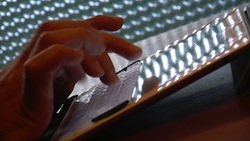 I love my iPad, which has now almost completely replaced my laptop for most applications. However, its lack of a physical keyboard can at times be limiting. Last year, I began a quest to overcome this shortcoming.
I began looking for accessories like iPad cases, which included Bluetooth keyboards, external keyboards, and voice recognition, but nothing seemed to be a satisfactory solution. Extra hardware succeeded in defeating the lightweight utility of the iPad and voice recognition was flakey and not practical in some work applications.
What was I to do?
Then late last year I was overjoyed to come across a project on the site Kickstarter, an online community where people with great ideas can crowdsource for funding, and the innovation promised to meet my needs perfectly. The idea on this case was Touchfire, a translucent, plastic membrane keyboard that magnetically connects to the iPad. This solution would provide the tactile feedback you need in order to know exactly where the onscreen keys are and is easy to remove and store when not in use.
I placed my order and eagerly awaited my new keyboard.
And I wasn’t alone. The project needed $10,000 in preorders to move ahead but ended up with over $200,000 from iPad owners seeing the value in a product such as this.
Initial delivery estimates were for mid-December 2011. With any luck I would have my new keyboard by Christmas.
However, understanding the bumps and bruises of new product development, I figured even with potential delays I could hope to have it by January.
But then manufacturing happened.
Working for an organization that specializes in collaborative manufacturing R&D, I am keenly aware of the challenges involved in actually making something. The barriers encountered from a great idea to design and finally to full scale production are massive and have the potential swallow great ideas whole.
So it’s no surprise that the Touchfire keyboard has run the manufacturing gauntlet.
Initial preproduction began in China but quality concerns and turnaround times (and most likely IP protection fears) reshored the effort back to the United States where it was met with a number of minor issues pushing back delivery.
 For most of us with experience in manufacturing, these delays are completely understandable and even predictable. Actually making things is hard. In this age of immediate digital downloads, people can often forget the trials and tribulations that come with manufacturing. You can’t download a patch for a defective physical product. Once it ships, that’s it.
So as I eagerly await the delivery of my Touchfire keyboard (hopefully this month!) I hope it serves as a lesson moving forward, a small example of how complex manufacturing really is. This keyboard is a relatively simple product compared to a car or an electronic device. But the challenges that pop up when we want to go from design to live production are real.
Editor's Note:
More About TouchFire
The ultra-thin, transparent and light (less than an ounce) TouchFire fits over the iPad’s on-screen keyboard without adding any bulk to the tablet. Although it’s soft and supple to the touch, the keyboard is stiff enough to allow you to rest your fingers on the keys without accidentally triggering the touch screen.
 But best of all is the fact that TouchFire provides the right amount of resistance and spring-back to feel like an actual keyboard – no longer do you have that pounding on a piece of glass sensation.
In the “Our Story” section of the Kickstarter web site devoted to the nascent product, the TouchFire team, Steve Isaac and Brad Melmon, talk about some of the hurdles they faced in making this innovative idea a reality.
Fortunately they have the experience required to solve the problems that inevitably plague any manufacturing project. Steve has been designing products for 30 years at companies like Sun Microsystems, GO and Microsoft. Brad is a product designer and mechanical engineer who has worked at HP, IDEO, Moto Development, and Speck designing everything from toys to computers.
Among their biggest challenges was to design a keyboard that was thin, light and flexible enough to live inside the iPad’s cover and, at the same time, provide enough resistance to allow people to type naturally. The devil is in the details – Brad designed a series of micro-structures that fit inside each key. According to the web site, “You can’t feel these micro-structures, but they contain carefully designed walls that provide the proper force resistance no matter how your finger strikes a key.”
The dynamic duo encountered and solved other manufacturing problems having to do with materials, coping with design changes made by Apple to its iPad line, and figuring out the best ways of incorporating the magnets into TouchFire.
As Phil Callihan notes in his story above, these kinds of glitches are a normal part of the manufacturing process.
Last we heard, TouchFire is soon to be launched and gives every indication of becoming a smashing success.
Check out the video below to learn more.


