

Back to the Future!
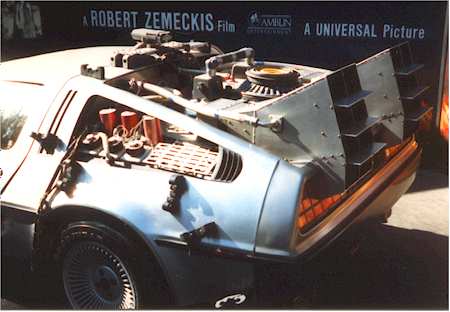 Remember the 1985 classic, Back to the Future! Near the beginning of the movie Marty McFly (Michael J. Fox) has a run in with Mr. Strickland, the chief marshal of Hill Valley.
Strickland says, “I noticed your band is on the roster for the dance auditions after school today. Why even bother, McFly? You don't have a chance. You're too much like your old man. No McFly ever amounted to anything in the history of Hill Valley!”
Replies McFly, “Yeah, well, history is gonna change.”
Today, history is changing all over our nation at an unprecedented pace. Recently I had the privilege to be part of an absolutely outstanding example of this change when I participated in the 5th annual MODSIM World Conference at the beautiful Virginia Beach Convention Center.
Consider the setting: A quick look at a map of Virginia shows Virginia Beach located a mere 10 miles from where the first settlers reached our shores in 1607. Within a few weeks the Jamestown settlement was created. Across the peninsula from Jamestown is Yorktown, the site of English surrender and the birth of our nation.
You can‘t get much more historic than that.
Back to the Future!
For four days in October nearly 1,000 professionals from government, academia and industry converged on this historic area to discuss the future – a future where modeling and simulation tools are affordably leveraged to impact a wide array of topics including:
• Defense, Homeland Security and First Responders
• Health & Medicine
• Human Dimension
• Serious Games and Virtual Worlds
• Education
And, lastly – Manufacturing!
This was the first year manufacturing was included as a session (at the request of the Administration). Presentations from NASA Langley, Intel, NCMS and OSTP participated in a spirited panel discussion to round out the afternoon.
Despite the great lineup of speakers, I have to admit, it was not the manufacturing track that had me most excited. It was the students attending the conference.
Literally hundreds of high school students with their parents and teachers attended the Wednesday night Dream, Create, Go! Event and Thursday’s STEM (Science, Technology, Engineering, and Mathematics) Day.
MODSIM World showcases and promotes the full spectrum of modeling and simulation education, K-12 to advanced degrees. The conference builds on various state and national STEM Initiatives. It demonstrates innovative solutions that use modern gaming technology to solve business, education, health and other challenges with compelling, engaging, and effective immersive experiences.
Why is this so important?
Well, I have read at least four articles over the past two weeks all highlighting this same statistic:
There are currently 600,000 manufacturing job openings in our nation today that have not been filled because manufacturers have been unable to find the properly skilled applicants.
We need to be training our current workforce and developing our future workforce. MODSIM World is one conference that is working on both. And it is not alone.
That is a very good thing. But is it enough?
There is a fundamental link between education, innovation and national competitiveness. To quote Bill Gates in an article in the Washington Post, he said “To remain competitive in the global economy, we must build on the success of such schools and commit to an ambitious national agenda for education.”
George W. Bush, in his 2004 State of the Union, said, “We must ensure that older students and adults can gain the skills they need to find work now. Many of the fastest-growing occupations require strong math and science preparation and training beyond the high-school level.“
Continuing the trend, Secretary of Education Arne Duncan, states, “In the knowledge economy, the opportunity to land a good job is all but gone if you drop out of high school or fail to get any college experience. That is why President Obama has repeatedly warned that the nation that out-educates us today is going to out-compete us tomorrow."
In his 2008 book, Change We Can Believe In, President Obama said, “I want to take us in a new and better direction. This agenda starts with education. A highly-educated and skilled workforce will be the key not only to individual opportunity, but to the overall success of our economy as well.”
It’s unanimous! Educate. Innovate. Compete. In that order.
The challenges facing our nation regarding education are very real – and very eye opening. According to 2006 PISA test scores in both mathematics and science, the United States ranked 25th and 24th, respectively. The top two countries for both of these categories were the same: Korea and Finland. Other countries finishing ahead of the U.S. included the Czech Republic, Poland and the Slovak Republic.
I agree with Bill Gates when he stated, “During the past 30 years, U.S. innovation has been the catalyst for the digital information revolution. If the United States is to remain a global economic leader, we must foster an environment that enables a new generation to dream up innovations, regardless of where they were born. Talent in this country is not the problem – the issue is political will.”
These innovations are what will drive tomorrow’s best practices, tomorrow’s engineers, tomorrow’s manufacturing.
MODSIM World is doing their part. We need to be doing ours.
Now what did I do with that flux capacitor?


